
FAMCO hosted a productive meeting for its members along with members of the campus staff union (OPEIU). FAMCO leadership presented the administration’s latest offer (about as bad as the last), and Barbara Caress (our health insurance consultant) provided expert commentary. Below, you’ll find the 30-minute presentation, a copy of the table from the video for reference, and an overview of how the latest offer measures up to FAMCO’s platform for health benefits.
The Administration’s Current Offer in Detail
This table is a big part of the presentation video above showing how the administration’s latest proposal compares to what we currently have in detail. Here it is for reference:
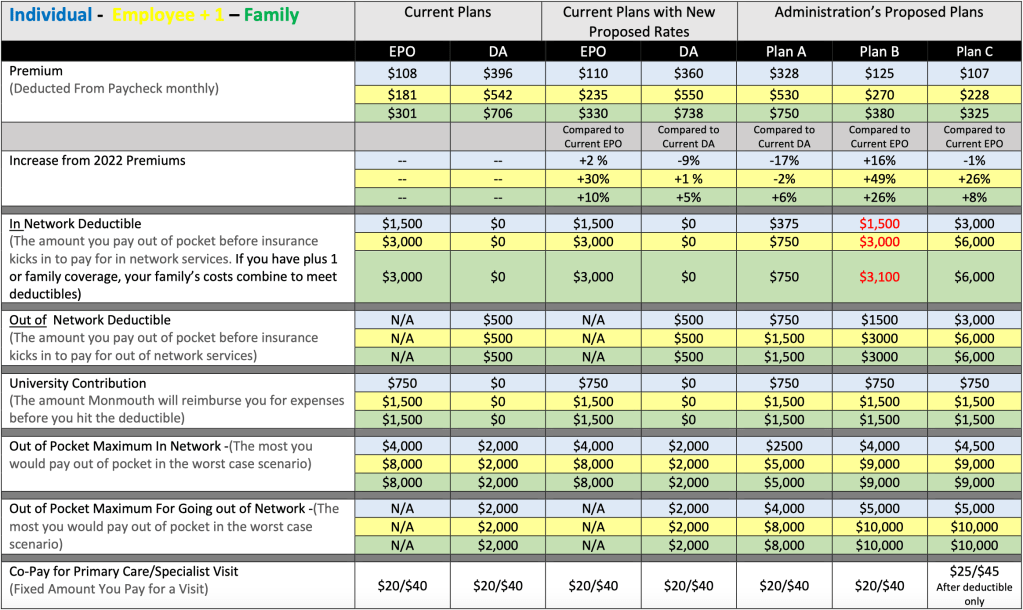
*Additional design cost changes proposed by the administration can be provided by request.
*The red deductible numbers in Plan B are a correction from the numbers displayed in the November 2, 2022 FAMCO update video presentation. The video number are (incorrectly) much lower.
How Does the Administration’s Proposal Line Up with FAMCO’s Platform?
Does their proposal lower premiums for all?
No. While some employees may see modest decreases in premiums if they were to switch to new plans, many would pay more, and some would pay MUCH more.
Does the proposal allow for plan choice?
The “choice” is in-name-only.
There is NO CHOICE to stay on the current DA at lower premiums. There is NO CHOICE for a comparable DA plan after 2025, even at higher premiums.
There is NO CHOICE for a plan with deductible levels that would not be a barrier to access combined with premium costs.
Does their proposal provide out of network benefits for all?
Out of network benefits “for all” is also in-name-only.
The high deductibles and high out-of-pocket maximums make an “out of network benefit” inaccessible to many employees, even if it exists technically in the plan. Adding an out-of-network benefit does not cost the university more, but employee premiums are being increased anyway. It doesn’t add up.
Does their proposal provide for transparency in healthcare benefits decision-making?
No. Their proposal eliminates the healthcare labor-management committee the union has established for over three years.
Does their proposal address the problem of escalating healthcare costs?
No. In fact, the administration has admitted in negotiations that they can financially afford the union’s proposals to lower premiums and allow real choice, and they have repeatedly rejected those proposals at the bargaining table.
—-
The administration has also indicated that they plan to bid out for new health benefits vendors as early as April 2023 (i.e. the University may move to another network, such as Aetna, or United Healthcare, for example, and/or may move to a new prescription benefits manager). That means that any changes in plan designs accepted now could be up for renegotiation in the year ahead.
 The Faculty Association of Monmouth University
Leave a comment