-
Good News! Monmouth University Remains Financially Healthy! Where Does the Money Go?
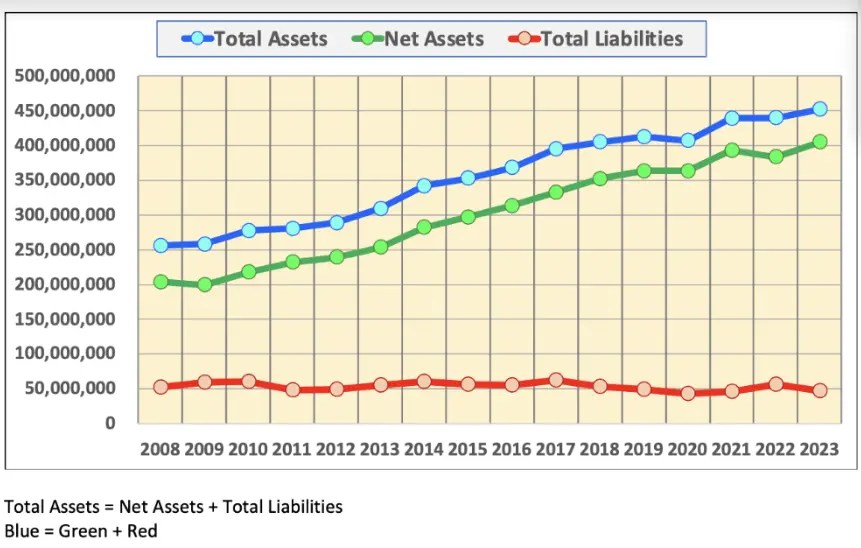
Amid rising educational costs, Monmouth University’s recent announcement of a tuition increase sparked concern among students and faculty, with calls for more financial transparency coming from both. The Faculty Association of Monmouth University (FAMCO), alongside AFT-NJ and AFL-CIO state leaders well as students, convened to discuss these pressing financial issues on April 10. As the graph with this post shows, the value of Monmouth University’s assets overall has risen consistently while financial liabilities remain stable and low, meaning the university’s financial health is great. Despite this, the University antagonizes faculty in contract negotiations (paying a high-priced outside lawyer to do so) and students don’t see this financial health showing in their daily experience. In a piece in the Monmouth Outlook, Kristen Frawley gave the following testimonial:
Kristen Frawley is a junior social work student and one of the students who spoke at FAMCO’s recent meeting. She said, “The recent tuition increase concerns me greatly because students cannot clearly see where this money is going and how it will benefit us. I question the school’s morals and ethics surrounding money allocation when I think about the fact that the top 15 administrative members earned a collective $4.4 million in 2022 while Counseling and Prevention Services are so underfunded and understaffed that students are limited to seven sessions per semester.”
These financial findings, set against the backdrop of ongoing contract negotiations and increased scrutiny over administrative salaries and resource allocation, underscores a growing discontent with how student fees are utilized and the tangible impact University budgeting has on the quality of education and services provided to students.
Check out the whole Outlook article below for a more detailed student take on the situation:
-
Bargaining Update #2: Progress Made Despite Employer’s Shameless Attack

On Tuesday, April 16th, the FAMCO bargaining team held our fourth negotiating session with the MU administration, lasting 8 hours. Present for the administration’s team, but largely inactive during the session, were Interim Provost Rich Veit, Associate Provost Susan Gupta, VP Christine Benol, VP Joseph Pingitore, VP Jim Pillar, HR Director Kathy Stein, and MU General Charlene Diana. Leading the negotiations for the administration, despite the substantial allocation of senior management time and university resources to their bargaining team, is an attorney from Gibbons Law, an external law firm President Leahy has retained to negotiate against the MU faculty.
Not only has President Leahy chosen to divert resources that could be used on instruction to outsource the important work of negotiating the successor contract with faculty, the lawyer he has hired has come late to every single session, including the first session where the administration came without a single proposal.
But this week’s behavior by President Leahy’s attorney of choice takes the cake: In an outrageous and chilling example of well-worn anti-union tactics, the administration’s team engaged in what appeared to be a premeditated attempt to conduct an ad hominem attack on one of our members, Professor John Comiskey, falsely accusing him of inappropriately canceling his classes to attend the bargaining session.
When pressed on how they came to believe this, management’s external counsel made misleading comments that suggested students had complained, and even went so far as to blame the lawyers’ lateness to the session on the premise that they “may have been” dealing with student complaints against Professor Comiskey, who just this semester received a national award from The Center for Homeland Defense and Security as educator of the year. When pressed further by FAMCO, the administration’s external counsel failed to confirm that there was, in fact, a real student complaint, or that their lateness was related to any need to address an actual student concern.
Instead, it appears to us that the university’s lawyers, both internal and external, chose to traffic in unsubstantiated claims about a faculty member’s adherence to professional duties as a way to distract attention from their own bad form, and to escalate a campaign to intimidate faculty who have stepped up to protect their colleagues and our academic mission.
This shameless behavior is a new low.
The FAMCO team made our outrage known, prompting the administration’s external counsel to make the absurd claim that they “did not come to the session to be attacked,” noting that, after all, the university has made significant investments in a management team to negotiate with faculty.
On their point that the university is incurring a serious expense in hiring high-priced lawyers, on top of the cost of releasing a provost, an associate provost, three vice presidents, and a human resource director from other university work to bear witness to outsiders bullying their own faculty, we can only agree.
The good news is that despite the shocking and flagrant attempt to falsely discredit one of our own team members, and amidst repeated attempts to delay responses to proposals FAMCO, the FAMCO team has been successful in moving us forward on expected tentative agreements on several non-economic items, pending review, including:
- establishing greater clarity in procedures for graduate faculty status appointment and continuances
- retaining faculty protections from unwarranted administrator access to eCampus shells
- providing for increased accountability in ensuring due process in grievance proceedings
- protecting COVID compassionate review provisions for faculty moving through the reappointment, tenure and promotion process
- expanding contract language that further asserts the parties’ shared values in ensuring a non-hostile, non-toxic workplace
There is additional good news to report, as members who attended the April meeting will know: FAMCO has been heartened to receive the support of concerned MU student leaders, as well as the support from our state leaders from AFT-NJ and from the New Jersey AFL-CIO.
Check out the terrific shout-outs and great photos in recent issues of the AFT statewide newsletter, as well as the jaw-dropping coverage of administration’s orientation toward our students’ concerns over the latest tuition hikes in this week’s Outlook below.
Going forward, the FAMCO bargaining team is back at the table on May 7 and May 15,and the time is now for you to do your part to win the strong contract we all deserve- for us and for the good work we know we are doing with our students!You can take the next step with us by marking your calendar for our upcoming May Day celebration on Wednesday, May 1st from 2:45pm-4:15pm in the upper level lobby and Pozycki patio for a chance to gather for some end-of-the-semester socializing and solidarity on this year’s International Workers Day!
-
Monmouth University Students Share What They Want from Bargaining
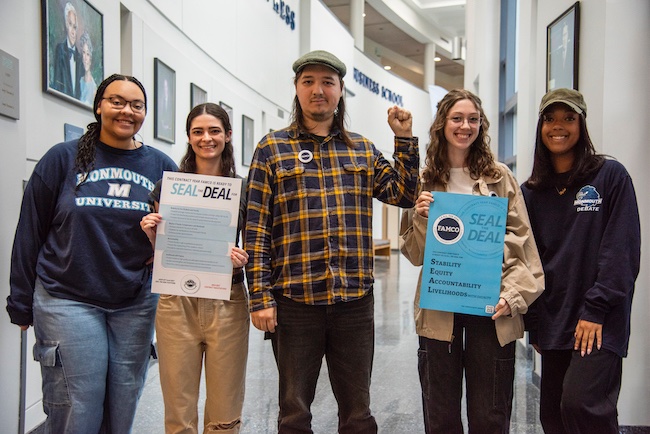
Students and members of the Monmouth University Social Justice club shared their concerns about the University with Faculty at the April 10th FAMCO Meeting on Campus. Student’s learning conditions are faculty working conditions, and students have a vested interest in things the bargaining process deals with, particularly in the areas of:
Money: Tuition keeps going up. As students, they want more transparency in how its spent, particularly since it looks, to them, like athletics get most of the benefit, and non-student athletes are starting to feel overlooked by the administration. Students want rising tuition to translate to better conditions for all students and their faculty.
Classes: Low guarantees of tenured or even full-time faculty positions means the University is relying more on contingent, part-time faculty who teach at multiple schools and can’t be as available or personable to students because they are pulled in multiple directions already. Faculty also have less time for research, which improves and updates their teaching. Overall, it’s getting harder for students to find required classes for their majors and minors because academic departments are short-staffed.
Graduate Programs: The University has been cutting down graduate scholarship and assistantship funding, turning graduate study at MU something that only wealthier people take on. Advanced degrees increase earning potential and workforce value, and should be available to people from all walks of life.
Campus: In general, it seems like many sectors of campus are short-staffed. Besides the academic side, campus clerical and upkeep seems short staffed and underfunded, meaning dorms are deteriorating faster (especially since all students must live in dorms for two years). Building, grounds, and maintenance staff need more funding to hire more people.
Advising: Departments across campus have lost faculty in the last few years, and with the University administration reluctant to replace them, it’s getting harder for students to get ahold of their major advisers because faculty are spread thinner.
Overall, students said they feel like they are not being set up for success and missing out on foundational knowledge because their professors are not being set up for success.
Administrators may prefer to think students don’t notice or care about things like this, or that campuses are trapped in sitcoms or retro movies where students and teachers only care about antagonizing each other, but the truth is that students and teachers share the most time together on campus, and we want what’s best for each other. We’re all here to make a difference and do our best. These students want the Monmouth University Administration to improve faculty working conditions AND student learning conditions with an equitable contract!
-
SEAL the DEAL Full 2024 FAMCO Platform!
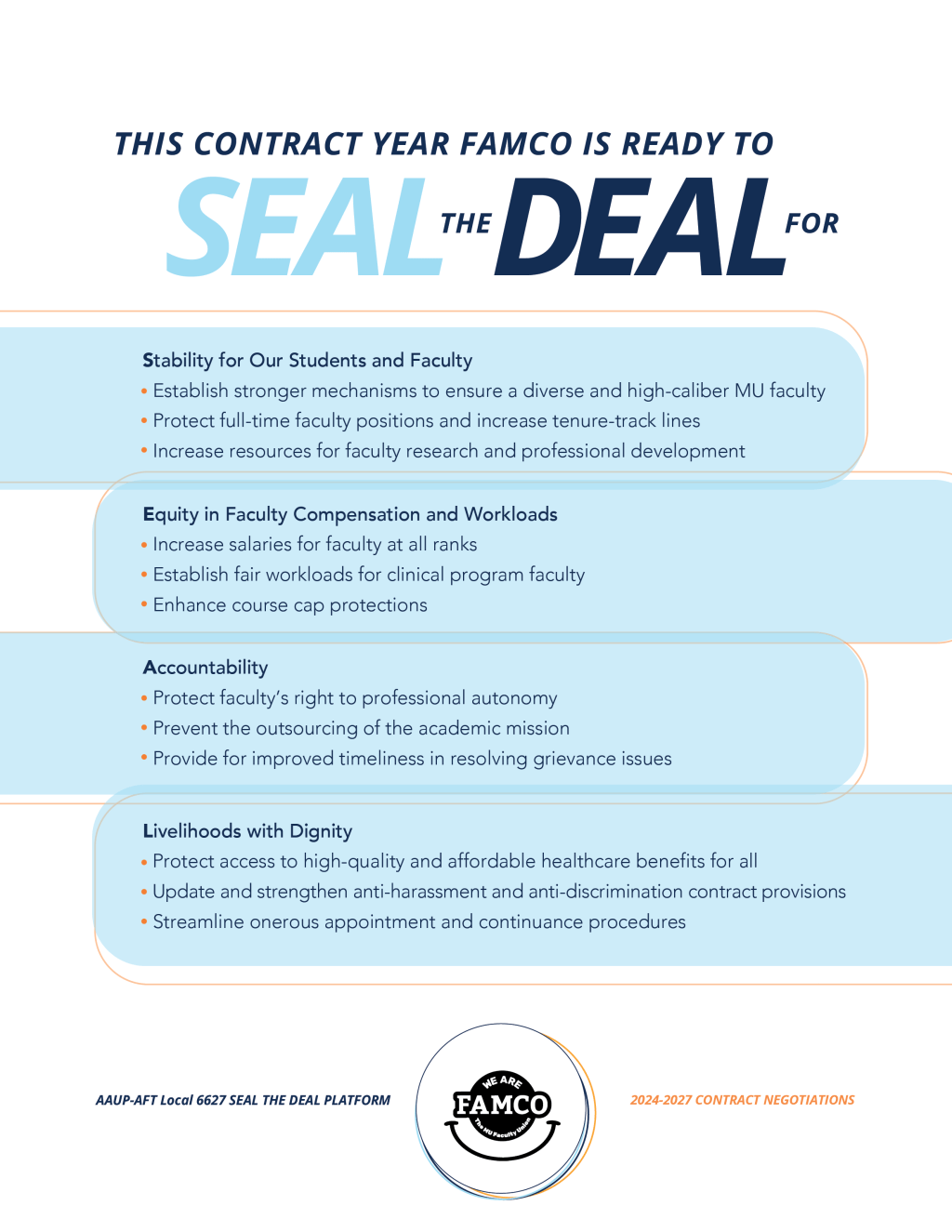
FAMCO is stepping into this pivotal contract year with a strong, progressive bargaining platform designed to uphold the dignity and security of our faculty and students. Our focus is firmly on SEALing the deal for a fair and equitable workplace, ensuring stability through the protection of full-time positions and tenure-track lines, and advancing equity with improved salaries and balanced workloads for all faculty members. The platform also prioritizes accountability, advocating for the faculty’s right to professional autonomy and timely grievance resolutions. We are also committed to protecting our community’s livelihood with robust healthcare benefits and reinforced anti-harassment and anti-discrimination measures. This comprehensive approach represents FAMCO’s dedication to fostering an academic environment where excellence and fairness go hand in hand. Join us as we work together to champion these essential changes and build a stronger future for our academic family!
-
Consultants at the Gates: The Future of Higher Education when Decision-making is Outsourced

Financial turmoil and potential academic restructuring at the University of Connecticut (UConn) has prompted a deeper examination of the influence of outside consulting firms in educational institutions. The faculty’s apprehensions center on Huron Consulting’s involvement in UConn’s cost-cutting measures, illustrating a broader, disconcerting trend in higher education: the increasing reliance on corporate strategies that sideline faculty input and prioritize efficiency over academic integrity. This article delves into these dynamics, the implications of Huron Consulting’s recommendations regarding faculty positions and academic programs, and the wider consequences these actions portend for higher education. Stakeholders and educators (including our own Marina Vujnovic) voice their concerns, showing why this issue demands our attention.
-
Bargaining Update #1: Admin Comes Unprepared, Draws Out Session, Can’t Commit to Next Meeting
Monday, February 19, 2024 marked a significant milestone for the faculty at Monmouth University as the FAMCO Bargaining Team initiated the first contract negotiation session with the university administration. Our Contract Action Team (CAT) and fellow FAMCO members displayed exhilarating enthusiasm beforehand, but the session unveiled a disheartening lack of preparation on the administration’s part (despite having hired a fancy, outside lawyer in John Romeo to run their side of the table), highlighting an apparent undervaluing of faculty needs and concerns. Despite this, FAMCO negotiators, unfazed in their commitment to advocating for Stability, Equity, Accountability, and Livelihoods with dignity (SEAL), presented a series of non-economic proposals aimed at reinforcing our shared values, enhancing support structures, and ensuring fair processes within our academic community. However, the employer’s absence of proposals and their looooong delay in reconvening signal a challenging road ahead. As we navigate these negotiations, the unity and collective action of our members will be crucial. Below is an account from this initial negotiation session, including the ongoing challenges of securing necessary information from the administration, and the vital steps FAMCO members can take to support our collective bargaining efforts. Together, wearing our “bargaining blue” S.E.A.L. the DEAL shirts every Wednesday, we stand in solidarity, pushing forward towards a fair and just contract.
#####
BARGAINING SESSION SYNOPSIS: February 19, 2024
This Monday, February 19, the FAMCO Bargaining Team conducted our first negotiating session with the employer from 11:30am to 2:00pm. We thank our Contract Action Team (CAT) and all our FAMCO colleagues who came this morning to cheer us on before the start of our bargaining session!
While the employer came unprepared and did not provide an opening statement and did not present any proposals, FAMCO presented a set of non-economic proposals to begin our…
Push for Stability, Equity, Accountability, and Livelihoods with Dignity (SEAL) with the Following FAMCO Proposals to…
- affirm our shared values and commitments to workplace civility;
- provide for grants office support;
- clarify graduate faculty status reappointment process;
- assure the continuation of the labor-management committee for IDEA and peer evaluations;
Right from the start, we were disappointed that the employer came to the table with no proposals. Additionally, the employer’s team told us they are unable to return to the bargaining table to present their initial proposals for at least another three weeks, sending a clear message to our faculty that our needs and concerns are not a top priority for administration.
In other news, the administration has still not provided FAMCO with the full list of information we requested back in October in anticipation of our return to the bargaining table, which previously compelled the union to file an unfair labor practice (ULP) charge against the University. This ULP charge remains open until the employer fulfills their obligation to provide the information the union is entitled to possess to bargain on behalf of the members.
On top of that, the administration has missed a second deadline to provide FAMCO new information we requested about our healthcare benefits program so that we can successfully prepare to bargain around those issues so vital for our members.
As of now, the administration has also failed to respond to our suggested follow-up dates to return to the table in the next month to begin in earnest.
What Can You Do Next to Support Your Union?
One easy thing we all can do to support our union is to turn out each Wednesday this semester wearing your new “bargaining blue” S.E.A.L. the DEAL-shirt! If you haven’t picked up your new blue shirt yet, please see your FAMCO department liaison so you are ready to “Wear It On Wednesdays” until the administration agrees to settle a fair contract for our faculty!
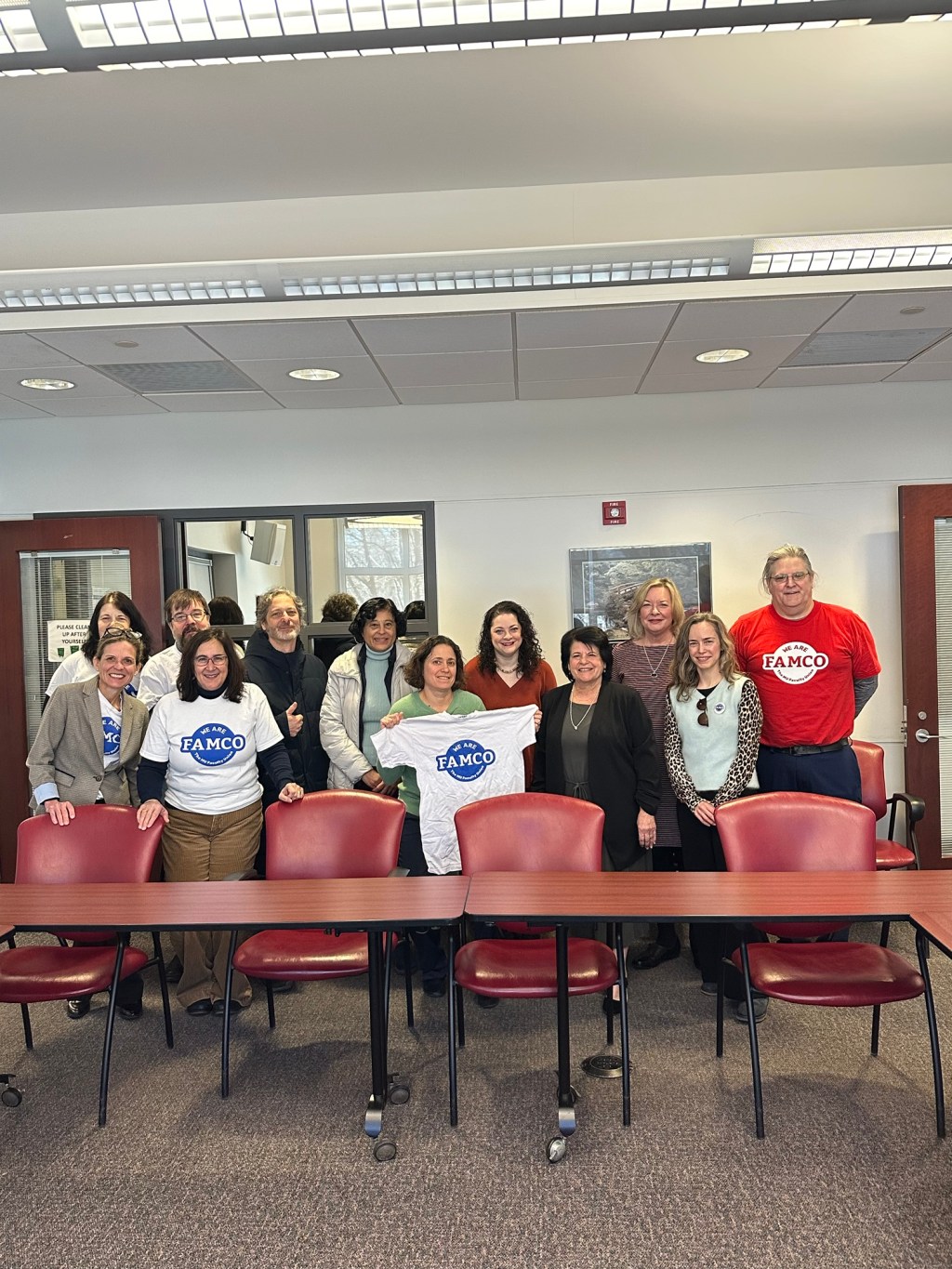
In the image above: fabulous FAMCO members welcomed members of the Bargaining Team in the Plangere Center on opening day! Stay on the lookout for further announcements on upcoming events planned to educate our community about the S.E.A.L. the Deal campaign, and for the next bargaining dates so that you, too, can come and support us at the table! GO FAMCO!
bargaining, faculty rights, labor-management relations, negotiations, union updates, workplace advocacyacademic labor rights, Accountability, bargaining, bargaining blue campaign, contract negotiations, equity, faculty union, FAMCO, healthcare benefits, labor-management committee, Livelihoods), SEAL (Stability, ULP, unfair labor practice, union solidarity, university administration, workplace civility -
Happy Martin Luther King Jr. Day

Happy Martin Luther King Jr. Day from all of us at FAMCO! Today, we honor the legacy of Dr. King, a heroic advocate for justice, equality, and the power of collective action. As educators and union members, we are inspired by his vision of a world where all people are respected and can thrive. His tireless work towards civil rights and labor rights reminds us of the critical role we play in shaping an inclusive and equitable society. Today, let us reflect on our shared values of solidarity, dignity, and the relentless pursuit of justice in our educational institutions and beyond that we want to embody every day. Dr. King’s dream continues to guide us as we stand together, united in our commitment to making positive impact in our communities.
-
Triumph Amidst Challenges: Securing Stable Healthcare Costs and Looking Forward to 2024

As the semester comes to a close, the FAMCO Executive Team sends our hearty congratulations again to our members on our collective efforts this fall to secure a zero percent increase on our health insurance premiums for 2024! This means that for the entire duration of the 2021-2024 collective labor agreement, we have been able to keep our healthcare costs stable for our members. That we have been able to keep our high healthcare costs stable in the context of a global health crisis, and in the face of historic levels of inflation, has made this work even more important. While there is much more to be done, we were also able to make headway in moving the needle toward correcting imbalances that have prevented a fair distribution of healthcare costs between the University and its employees.
This fall’s healthcare rate agreement for 2024 did not come easy, however, and FAMCO made a major concession with the University on the addition of two new plans to the faculty benefits program. We conceded this significant change to help support our members’ overall health and wellness in 2024 as they manage, among other pressures, extraordinary cost of living increases that have not been matched by increases to faculty compensation.
Going into the 2024 bargaining season, we look forward to continuing our negotiations with the University on issues that matter most to our faculty. We also expect that the University will be prepared to acknowledge the complete picture of what faculty continue to contribute to the success of Monmouth, including the full extent of the economic and workload challenges faculty have weathered over the past several years.
In the meantime, please mark your calendars for our next regularly-scheduled member meeting on Wednesday, January 17, from 2:45pm-4:15pm in Bey Hall Young Auditorium to help us kick off another great FAMCO year! Happy Holidays to all and see you in 2024!
The Faculty Association of Monmouth University
Monmouth University Faculty for Academic Freedom
Get FAMCO updates directly in your inbox.

